
Most sprinkler systems are planned backward. Someone decides how many heads a yard “needs,” buys them, and only discovers the problem when the last two heads on a zone barely dribble while the first two spray fine. The heads were never the limiting factor — the water supply was. Planning a system that actually works, and that satisfies California’s landscape water rules on a project that triggers them, starts at the meter, not the nozzle.
Before you pick a single sprinkler head, get four numbers and facts straight:
- 1Static pressure and available flow (GPM) at your meter set the ceiling for everything else — measure them before you design zones, not after.
- 2Each zone should use no more than about 75% of your available flow, since only one zone runs at a time; that margin keeps pressure — and coverage — from collapsing.
- 3New landscaping of 500 sq ft or more (or rehabbed landscaping over 2,500 sq ft) that needs a permit, plan check or new water meter triggers California’s Model Water Efficient Landscape Ordinance — a smart controller, backflow prevention and pressure regulation become requirements, not upgrades.
- 4Your local water provider can add its own rules on top of the state ordinance — backflow testing obligations and watering-day restrictions in particular, and those change with drought conditions.
Start with your water supply, not the heads
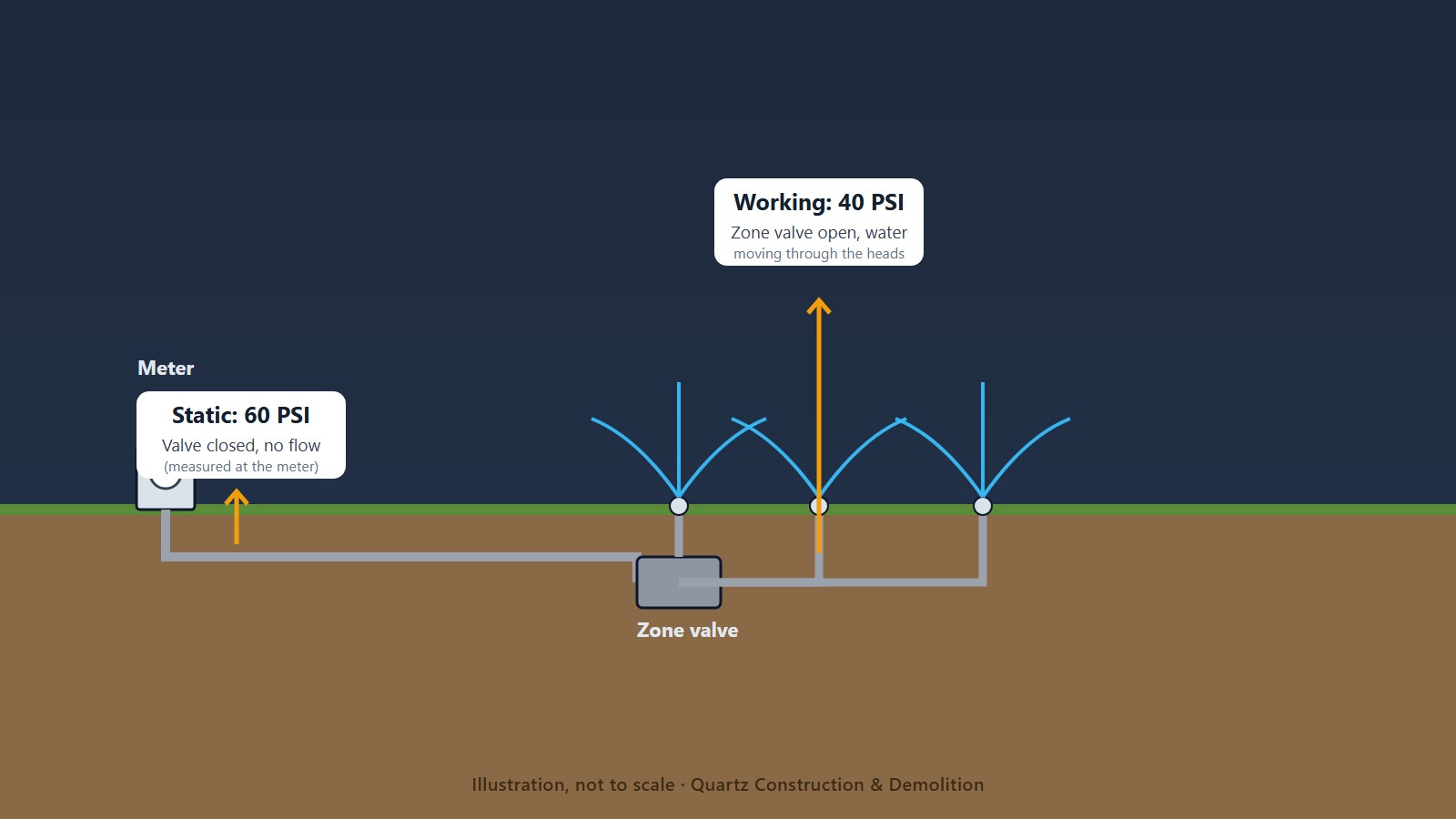
A sprinkler system runs on two numbers: pressure (PSI) and flow (GPM, gallons per minute). Both come from your water supply, not from any catalog. Static pressure — the pressure sitting in the line when nothing is running — is measured with a gauge threaded onto an outside hose bib, or you can ask your water provider for the figure at your address. The number that matters is the worst case: summer, daytime, when everyone on the block is watering and pressure is at its lowest, not a mild reading taken on a cool evening.
Available flow takes more work to pin down, because three separate limits apply and the lowest one wins: pressure loss through your water meter shouldn’t exceed about 10% of your static pressure, flow shouldn’t exceed roughly 75% of the meter’s rated safe maximum, and velocity in the service line should stay in a 5–7.5 feet-per-second range. Whichever of those three rules produces the smallest number is your system’s real capacity — oversizing past it risks meter damage and chronic pressure loss, undersizing just wastes money on a system that can’t use the flow you actually have.
- Step 1Read static pressureThread a pressure gauge onto a hose bib and read it on a summer afternoon, or ask your water provider for the figure at your service address.
- Step 2Find your meter sizeIt’s usually stamped on the meter or on file with your water provider — this sets the meter-loss and max-flow limits.
- Step 3Apply the three flow rulesMeter loss, max safe meter flow and service-line velocity each cap your GPM differently. The lowest result is your real available flow.
- Step 4Write both numbers downStatic PSI and available GPM are the two figures any designer, or any head you pick yourself, has to work within.
Why zones exist, and how big each one can be
A zone is a set of heads controlled by one valve, run on their own schedule. Zones exist for two reasons: different parts of a yard need different amounts of water, and no residential water supply has enough pressure and flow to run every head on a property at once. Heads also don’t mix well across types — rotors, sprays and drip emitters operate at different pressures and apply water at very different rates, so combining them on one zone means some heads are starved while others are overwatered.
- Spray heads — 20–30 PSI, roughly 0.5–3.0 GPM per head. Good for small lawn areas and tight planting beds.
- Rotors — 40–60 PSI, roughly 1.0–10+ GPM per head. Cover larger, open lawn areas with fewer heads.
- Drip emitters — 20–30 PSI, a small fraction of a spray head’s flow per emitter. Built for shrub beds, planters and anywhere overspray is wasteful.
Zone size comes back to the same available-flow number from the water-supply step. Because a standard controller runs one zone at a time, the limiting rule is simple: a well-designed zone stays at or under about 75% of your total available flow, leaving a margin for pressure fluctuation and for heads that wear or drift out of spec over time.
California’s state irrigation rules (MWELO)
California’s Model Water Efficient Landscape Ordinance, at 23 CCR Division 2 Chapter 2.7, applies once a project crosses a size threshold and needs a permit, plan check or new water meter: new landscaping of 500 square feet or more, or rehabilitated landscaping where the existing area is over 2,500 square feet. A straightforward swap of a few heads on an existing system typically stays under the radar; a new install tied to a remodel, an addition, or enough replanting to need a permit usually does not.
Below the threshold
- Small repairs, head swaps or zone additions on an existing system with no permit or new meter involved
- No new landscape permit or plan check triggered
- State ordinance components aren’t mandatory, though they’re still good practice
At or above the threshold
- A smart, weather- or soil-sensor-based controller with a rain sensor
- A manual shutoff valve at the point of connection
- A backflow prevention device
- Pressure regulation where system pressure exceeds component ratings
- A flow sensor with master shutoff valve on larger landscapes
Those requirements aren’t arbitrary — they map directly onto the planning numbers from the sections above. A pressure regulator exists because your static pressure may run higher than what spray heads or drip tubing are rated for. A backflow device exists so irrigation water, including anything picked up from fertilizer or soil in the line, can never be pulled back into drinking water. A smart controller exists so the system waters based on actual weather or soil moisture instead of a fixed timer nobody adjusts after installation.
Local rules stack on top of the state ordinance
MWELO is a floor, not a ceiling. Local water providers can add their own requirements, and the backflow rule is one Bay Area homeowners run into even outside MWELO-triggered projects: if a property has a well used only for irrigation, EBMUD requires an approved backflow preventer to be installed and tested annually regardless of whether that well ever touches the household supply, and the customer is responsible for installing, testing and maintaining it — typically with about 30 days to comply once notified.
Watering-day and time-of-day restrictions vary by provider and change with drought conditions. Don’t assume a fixed schedule applies at your address — check your water provider’s current rules (for EBMUD customers, that means ebmud.com) before you lock in zone run times, especially if you’re programming a controller that won’t be revisited for months.
A planning checklist before you call for quotes
Works as a plain list without JavaScript; with it on, you get a progress bar and your ticks are remembered in this browser only.
Before you design or quote a system
Tick each item as you work through it.
When a professional design earns its fee
A lot of this is reachable with a gauge, a tape measure and an afternoon. Where it gets harder to do alone: properties with more than two or three zones, where one wrong flow calculation on zone one throws off every zone after it; sloped yards, where low-head drainage and pressure differences between the top and bottom of a run complicate head selection; any project that crosses the MWELO threshold and needs plans a city will actually accept; and troubleshooting an existing system that’s underperforming, where the real cause is often a supply-side number nobody checked rather than a bad head. A designer who measures your actual pressure and flow before drawing zones is doing the same homework this guide walks through — just with the tools and experience to catch what a first pass misses.
Questions homeowners ask
Does a new sprinkler system need a permit in California?
It depends on size and scope. California’s state ordinance (MWELO) applies to new landscaping of 500 square feet or more, or rehabilitated landscaping over 2,500 square feet, when the project needs a permit, plan check or new water meter. A simple repair or a few added heads on an existing system usually doesn’t trigger it; a new system tied to a larger landscape or remodel project often does.
What is a hydrozone?
A hydrozone is a section of landscape grouped by how much water the plants in it need — for example, lawn, drought-tolerant shrubs and a vegetable bed are three different hydrozones. Each hydrozone typically gets its own irrigation zone so it can be watered on a schedule that matches its actual need, instead of one setting trying to serve plants with very different water demands.
How many sprinkler heads can go on one zone?
It depends on your available flow, not a fixed number. Add up the GPM rating of each head you’re considering for a zone and keep the total at or under roughly 75% of your available flow at the meter. A zone of high-flow rotors may only fit two or three heads; a zone of low-flow drip emitters can fit far more.
Do I need a backflow preventer for a drip irrigation system?
Generally yes — backflow prevention protects the drinking water supply from anything that could be drawn back from an irrigation line, regardless of head type. It becomes a formal requirement under MWELO for qualifying projects, and separately, some Bay Area water providers such as EBMUD require an approved, annually tested backflow preventer on any irrigation well connection even outside a MWELO-triggered project.
What’s the difference between static and working pressure?
Static pressure is what the line reads when nothing is running. Working (or dynamic) pressure is what’s left once a zone valve opens and water starts moving — it’s always lower than static, and it’s the number that actually determines whether your heads perform correctly. A system designed around static pressure alone will usually underperform once it’s actually running.
Does MWELO apply to a small backyard sprinkler upgrade?
Usually not on its own. The state ordinance is tied to a size threshold (500 sq ft new, 2,500 sq ft rehab) combined with needing a permit, plan check or new water meter. Swapping heads, adding a zone, or other small work on an existing system typically falls under that threshold, though it’s worth checking with your city or water provider if your project is close to the line.
Ready to plan a system that fits your actual water supply?
We measure pressure and available flow before we design a single zone. Quartz Construction & Demolition holds California contractor license #1003436, which you can verify on the CSLB website.
Related services and guides
- ServiceIrrigation system installation
- GuideIrrigation system installation cost in the Bay Area
- GuideBay Area drainage and irrigation solutions
- GuideFrench drain installation guide
Sources
Watch Our Work in Action
Watch our project videos on YouTube
Watch on YouTube- EBMUD, Water Efficiency Review — MWELO applicability thresholds (500 sq ft new / over 2,500 sq ft rehabilitated landscaping requiring a permit, plan check or new meter) and required irrigation plan components: smart weather- or soil-sensor-based controller, point-of-connection shutoff, backflow prevention device, pressure regulators, and flow sensor with master shutoff for larger landscapes (checked October 9, 2026).
- EBMUD, Backflow Prevention — backflow preventer requirement for irrigation wells, customer responsibility for install/test/maintenance, and the roughly 30-day compliance window after notice (checked October 9, 2026).
- Rain Bird, Irrigation Design Tip — Water Supply — measuring static pressure (gauge reading or water-purveyor figure, worst-case summer/daytime condition) and the three flow-capacity rules (meter loss, max safe meter flow, service-line velocity) (checked October 9, 2026).
- Rain Bird, Understanding Irrigation Hydraulics: PSI, GPM and Pipe Sizing Basics — operating pressure and flow ranges by head type, and the 75%-of-available-flow rule for sizing a zone (checked October 9, 2026).
- CSLB Check a License — verify any contractor’s license, including ours (#1003436).
General planning information, not an engineered irrigation plan. MWELO thresholds and local water-provider rules shown here reflect EBMUD’s published guidance; other Bay Area cities and districts may apply the ordinance with their own local amendments. Confirm current requirements and watering restrictions with your city and water provider before finalizing a design.
What Our Customers Say
"I had small repair job needed for my mother. They responded quickly and did excellent work and I will definitely use them again."
"I had a great experience working with Ohad and his team on my yard project! From start to finish, the communication..."
"We just finished backyard renovation and pergola project with Quartz Construction and Demolition. From start to finish..."