
Stamped concrete loses its color depth and water repellency long before the slab itself wears out — and the fix is almost always a reseal, not a replacement. The hard part is knowing when: resealing too often builds up coating that is expensive to strip, and resealing too late lets water and chlorides reach the surface. Here is what the American Society of Concrete Contractors’ Decorative Concrete Council (DCC) says about sealer types, how resealing intervals actually work, and the application-window and mistake patterns that matter most in Bay Area weather.
- 1There is no fixed number of years. ASCC’s own guidance says reseals should happen “as needed” based on fading color and loss of water/stain repellency — not on a calendar.
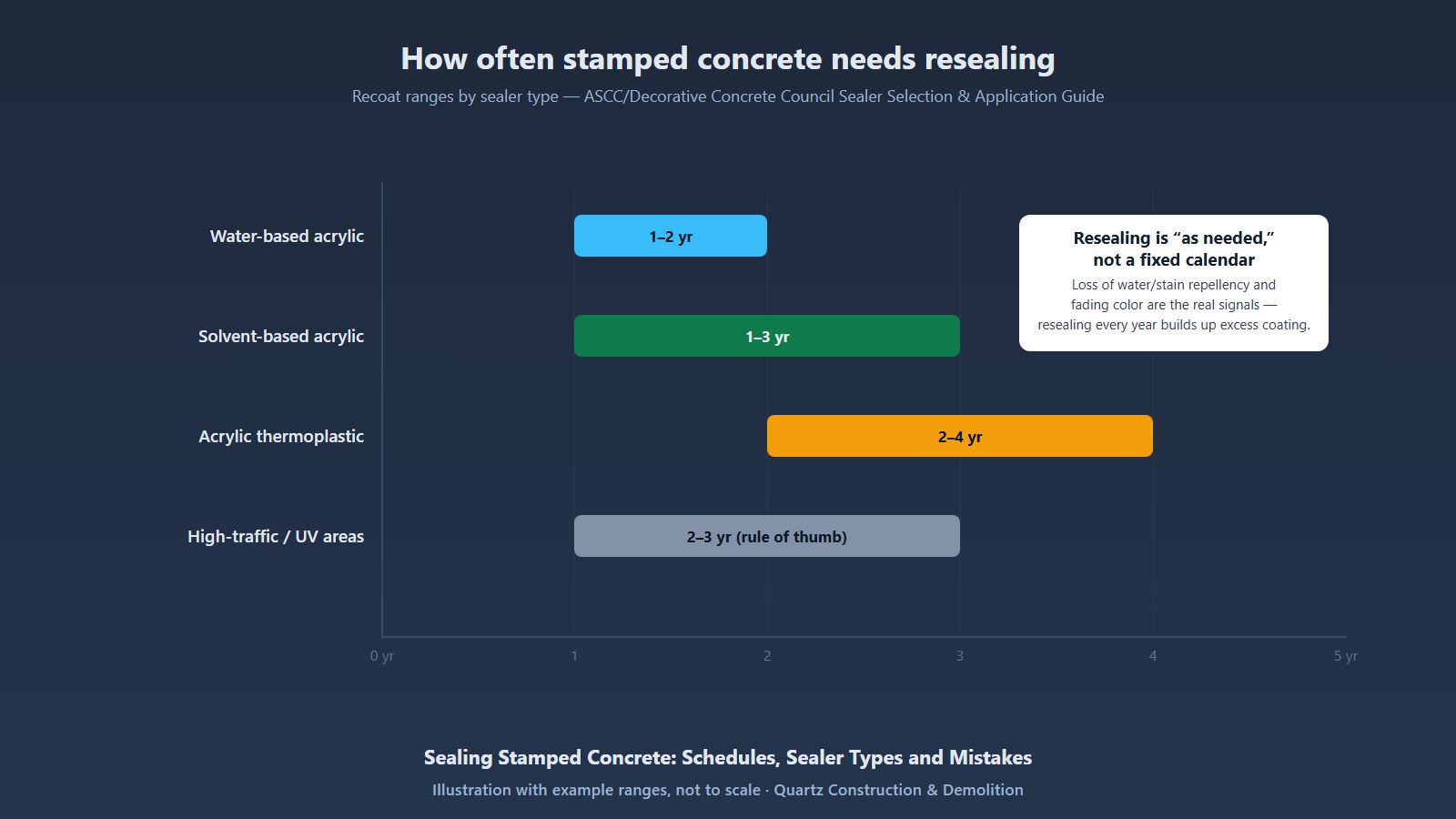
- 2Sealer type sets the realistic range. Water-based acrylics typically need recoating every 1–2 years, solvent-based acrylics 1–3 years, and tougher acrylic-thermoplastic (cure-n-seal type) products 2–4 years.
- 3Traffic and sun exposure move you within that range. A general rule of thumb: 2–3 years for high-traffic, UV-exposed patios and driveways; 4–5 years for lighter-traffic or shaded/interior surfaces.
- 4Most sealer failures trace back to application conditions, not the product — sealing too thick, in direct sun, on a damp surface, or outside the temperature window causes most of the bubbling, blushing and whitening problems homeowners see.
Why stamped concrete needs sealer in the first place
The DCC’s own best-practices note in Concrete International is direct about the purpose: decorative concrete contractors seal stamped concrete to protect it from water intrusion, deicing chemicals and staining, and to enhance its appearance. A sealer is a sacrificial coat — it wears so the slab underneath doesn’t. Left unsealed or under-maintained, a stamped surface can still look fine for years, but it loses the color depth that made the stamping worth paying for, since light reflecting off a worn sealer scatters instead of showing the color clearly.
Penetrating vs. topical and hybrid sealers
ASCC/DCC groups sealers into three categories, and which one is on your patio changes the whole maintenance conversation.
Topical & hybrid (film-forming)
- The most-used option for stamped concrete, because the film enhances color
- Builds a protective film on the surface; can double as a curing membrane
- Is what most of the recoat-interval numbers below apply to
Penetrating (water-repellent)
- Soaks into the concrete’s pores instead of forming a film
- Preferred where there is no routine maintenance plan (common on commercial work)
- Does not enhance color on most products, and generally needs the concrete fully cured first
Most residential stamped patios and driveways use a topical or hybrid acrylic specifically because it keeps the stamped pattern’s color looking the way it did on installation day. That is also why those are the products with the resealing intervals below — a penetrating sealer is a different maintenance conversation entirely, and the manufacturer’s data sheet for that specific product is the right reference.
How often to reseal, by sealer type
- 1–2 years — water-based acrylic sealers (including silicone-fortified water-based acrylics)
- 1–3 years — standard solvent-based acrylic sealers
- 2–4 years — acrylic-thermoplastic (“cure-n-seal”-type) solvent-based sealers
Those ranges come from the ASCC/DCC Sealer Selection & Application Guide’s own product-selection chart. The guide also gives a separate rule of thumb that applies regardless of product: higher-traffic and UV-exposed areas (a sunny driveway or pool patio) should get new sealer every 2–3 years, while lighter-traffic or shaded/interior surfaces can often go 4–5 years. Both numbers are ranges, not deadlines — the guide is explicit that resealing should be done “as needed” based on condition, not on a set schedule.
That matters because over-resealing is its own problem. Trying to keep a surface at a high-gloss shine by resealing every single year leads to coating buildup that becomes time-consuming and expensive to remove later. If the goal is just restoring shine on a sealer that is still sound, treating the surface with the right solvent is often a more efficient way to maintain it than adding another full coat.
Signs it’s actually time — not just “a few years”
Rather than watching the calendar, ASCC/DCC points to condition: loss of water and stain repellency, and a visible drop in color depth, are the two main reasons to reseal. In practice, that shows up as:
- Water stops beading on the surface and instead soaks in
- The stamped color looks flat, chalky or faded compared to when it was last sealed
- Blotchy, uneven patches appear — especially noticeable when the surface is wet
- New stains (oil, leaves, rust) set into the concrete instead of wiping off the sealer film
None of these are urgent structural problems — they’re maintenance signals. A slab that shows them is still protected by whatever sealer is left; it just isn’t being protected as well as a fresh coat would protect it.
The application window in Bay Area weather
Sealer is sensitive to the conditions it’s applied in, and the Bay Area’s swings between foggy mornings, hot inland afternoons and a wet winter season all matter here. ASCC/DCC’s application guide gives specific temperature limits:
A few Bay Area-relevant consequences follow directly from those numbers. Inland cities regularly run well past 85–90°F on summer afternoons, which pushes both sealer types out of their application range in the middle of the day — ASCC/DCC’s own fix is to work early or late, specifically at a time of day when the slab temperature will be falling for the next 3 to 4 hours, which can mean limiting application to evening hours in hot weather. At the other end, a cool, damp morning after fog or marine-layer moisture is exactly the condition that causes water-based sealer to dry white or powdery instead of clear, because the coalescing solvent evaporates before the water does. And in any season, the guide is explicit that you should not seal a surface when rain or condensation is expected within 12 hours of placement — worth checking twice during the Bay Area’s wet season (roughly November through April).
Avoid direct sunlight during application, especially when resealing. ASCC/DCC warns that sealing an already-coated surface in direct sun can trap bubbles between the new and existing layers and weaken the bond. Shade, overcast conditions, or early/late timing all help — not just for comfort, but for the bond itself.
Preparing the surface before resealing
- Step 1Power wash at 3,500+ psiASCC/DCC names this as the most effective cleaning method; a light phosphoric or muriatic acid wash can open the pores and remove old release agents if needed, always followed by a neutralizer/degreaser and a clean-water rinse.
- Step 2Strip loose or failing sealerFlaky, discolored acrylic should come off by sand/soda blasting, high-pressure washing, or a chemical stripper before any new sealer goes down — sealing over failing sealer just traps the problem underneath.
- Step 3Clear standing water and dry 12–24 hoursA leaf blower removes standing water from the slab and any saw cuts; the guide recommends letting the surface dry 12 to 24 hours before sealing, longer if moisture is suspected.
- Step 4Match the original sealer type if possibleRe-sealing with an incompatible product (water-based over an unknown solvent-based sealer, for example) is one of the documented causes of trapped-solvent whitening — matching the original, or testing a small area first, avoids it.
- Step 5Apply thin, even coats by spray-and-back-rollASCC/DCC calls spray-and-back-roll the preferred method at a coverage rate of roughly 200–350 sq ft per gallon; “dip-and-roll” tends to leave an uneven, excessive film.
Common sealing mistakes and what causes them
Four problems account for most of the sealer complaints ASCC/DCC’s troubleshooting guide documents, and all four trace back to application conditions rather than a defective product.
Bubbling or blistering
Small bubbles that pop or shatter underfoot, usually worst in low spots or joints. The guide lists two causes: sealer applied too thick (fix: thin, uniform coats with no puddling in low areas), and sealer applied outside the manufacturer’s temperature range — a hot surface makes it bubble or crack, a cold surface leaves it sticky or powdery. Once it happens, the fix is a solvent wash and starting over, not another coat on top.
Efflorescence vs. whitening — often confused
Efflorescence is a white, powdery substance caused by water evaporating out of the concrete itself and leaving soluble salts behind; it’s a concrete-mix issue (high water-to-cement ratio), made more likely by cold-weather placement, and is frequently mistaken for a sealer problem. True sealer whitening is different: it happens when moisture — water vapor or solvent — gets trapped inside the sealer film, from sealing over a damp surface, mixing incompatible sealer layers, or applying water-based acrylic too thick or without mixing it thoroughly.
Adhesion failure
Sealer that flakes off in a scattered, dot-like pattern usually traces back to excess release agent left on the surface before sealing. On stamped concrete finished with powdered release, ASCC/DCC specifies removing at least 75% of it before sealing — especially in high-traffic areas, where leftover release is the most likely cause of early peeling.
Questions homeowners ask
How do I know if my stamped concrete needs resealing?
Watch the concrete, not the calendar: water no longer beading on the surface, faded or chalky color, blotchy patches when wet, or stains that are starting to set in are ASCC/DCC’s documented signs. Sealer type and exposure then set roughly how often that happens — 1–2 years for water-based acrylic up to 2–4 years for acrylic-thermoplastic products, sooner in high-traffic, UV-exposed areas.
Can I reseal stamped concrete myself?
The prep work (power washing, stripping failing sealer, matching the original product) and the temperature/humidity window are where most DIY reseals go wrong. ASCC/DCC’s own guidance notes that resealing is best performed by a qualified, trained contractor — largely because getting an even coat without bubbling, whitening or blotching depends on experience with those variables.
Is it bad to reseal stamped concrete every year?
Yes, if the goal is just keeping a high-gloss shine. ASCC/DCC specifically warns that resealing more often than necessary builds up coating that becomes time-consuming and expensive to remove. If the existing sealer is still sound and you just want the shine back, a solvent treatment is usually a better fix than another full coat.
What’s the best time of year to seal stamped concrete in the Bay Area?
Aim for conditions near 50–65°F with the air and surface temperature close together, and avoid applying when rain or condensation is expected within 12 hours. In practice that usually means spring or fall, or early morning/evening during summer heat spikes, while steering clear of the wettest stretch of the rainy season (roughly November–April).
Due for a reseal, or planning a new stamped surface?
We can assess an existing stamped patio or driveway and tell you whether it needs a reseal, a strip-and-reseal, or nothing yet — and we install new stamped concrete with sealer included. Quartz Construction & Demolition holds California contractor license #1003436, which you can verify on the CSLB website.
Related services and guides
- ServiceStamped concrete
- GuideStamped concrete patio cost
- GuideConcrete sealing & maintenance guide
- GuideConcrete cracks: normal vs. a problem
Sources
Watch Our Work in Action
Watch our project videos on YouTube
Watch on YouTube- American Society of Concrete Contractors – Decorative Concrete Council, “Sealing Stamped Concrete” best-practices note (published in Concrete International, March 2025) — sealer purpose, penetrating vs. topical/hybrid types, curing-before-sealing timing, cleaning method (3,500 psi power wash, acid wash/neutralize), drying time (12–24 hr), application method (spray-and-back-roll, 200–350 sq ft/gal), “as needed” resealing basis, avoiding direct sun and the falling-temperature application window (checked October 24, 2026, PDF text extracted directly).
- ASCC/Decorative Concrete Council – Sealer Selection & Application Guide — recoat time frames by sealer category (water-based acrylic 1–2 yr, solvent-based acrylic 1–3 yr, acrylic thermoplastic 2–4 yr), general 2–3 yr / 4–5 yr traffic-based rule of thumb, application temperature ranges (45–90°F water-based, down to 40°F solvent-based, 50–65°F ideal), 12-hour no-rain rule, over-resealing buildup caution, and the troubleshooting entries for bubbling/blistering, efflorescence/blushing, whitening and adhesion failure (checked October 24, 2026, PDF text extracted directly).
- CSLB Check a License — verify any contractor’s license, including ours (#1003436).
General information, not a product recommendation or a Quartz quote. Always follow the specific sealer manufacturer’s data sheet, which can vary from the general ranges above.
What Our Customers Say
"I had small repair job needed for my mother. They responded quickly and did excellent work and I will definitely use them again."
"I had a great experience working with Ohad and his team on my yard project! From start to finish, the communication..."
"We just finished backyard renovation and pergola project with Quartz Construction and Demolition. From start to finish..."