
A Bobcat skid steer is really a hydraulic power source on tracks — what it actually does on a job depends on what’s bolted to the front of it. Homeowners usually only picture the bucket, the attachment that shows up in every stock photo. But a bucket can’t drill a clean post hole, pull a stump out by the roots, or turn a wall of overgrown brush into mulch without hauling a single truckload off site. Here’s what each of the four most common attachments actually does, and why the right one changes a job’s timeline more than the machine underneath it does.
Four attachments cover most residential site work:
- 1Bucket — the default. Digs, lifts, loads and grades. If a job is mostly moving soil, debris or spoils, this is usually all that’s needed.
- 2Auger — drills a straight, consistent round hole, typically to around 4 feet deep. Built for posts, footings and planting holes, not general digging.
- 3Grapple — hydraulic arms clamp and hold irregular loads a bucket can’t contain: root balls, brush piles, rock, demolition debris.
- 4Mulcher — shreds standing brush and small trees into mulch in place, which skips the haul-off trips a bucket-and-grapple clearing job needs.
Bucket: the default, and its limits
The bucket is the attachment a skid steer ships with, and for most residential work — moving soil, loading debris, rough grading, carrying broken concrete — it’s also the right tool. Bobcat’s own attachment line splits buckets into a few working categories: general-purpose buckets for digging and loading, and grading buckets built specifically for leveling and finish work rather than digging. The common thread across all of them is simple: a bucket lifts, loads, digs or grades material it can scoop and carry as a contained load.
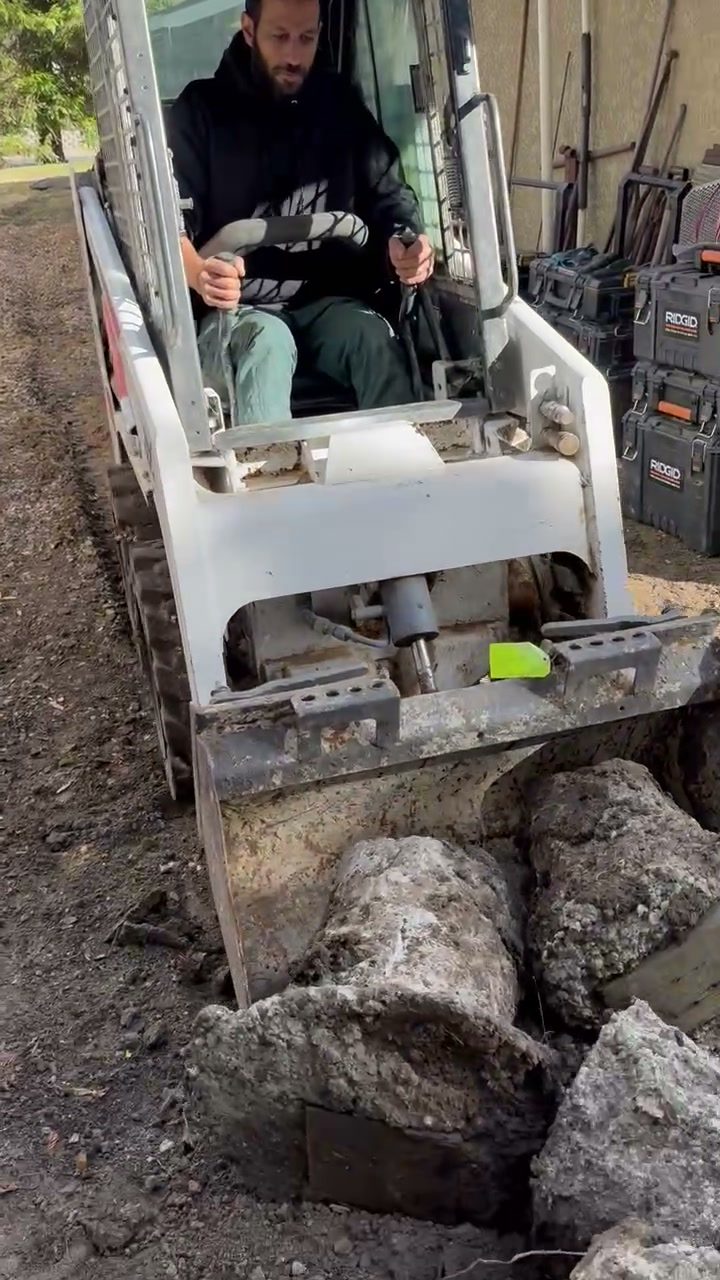
Where a bucket runs out of road: anything that isn’t a loose, scoopable load. A root ball tangled in soil, a pile of brush that keeps spilling out of the bucket’s open top, a straight round hole for a post — none of those are bucket jobs, which is exactly where the other three attachments earn their place on a jobsite.
Auger: drilling a consistent hole
An auger attachment replaces digging with drilling. It’s a hydraulically powered unit — a rotating drive head turning an auger bit — that cuts a straight, consistent round hole instead of the wider, looser excavation a bucket leaves behind. According to Bobcat’s own attachment specifications, a standard setup drills to roughly 4 feet deep, with extensions available for deeper holes, and the operator can adjust rotation speed and torque to match ground conditions.
- Typical uses: fence and sign posts, deck and pier footings, tree and shrub planting holes, and soil sampling.
- What changes the result: matching the bit’s diameter and the attachment’s hydraulic flow and torque to the ground — soft soil, compacted ground, rock and frost-affected soil all drill differently, and a bit that’s too wide or too tough for the ground slows the hole down considerably.
Grapple: holding what a bucket can’t
A grapple adds a second set of hydraulic arms over (or built into) a bucket-style base, so the attachment can clamp a load instead of just scooping it. That clamping action is the whole point: a bucket lets loose, bulky material spill back out as it’s carried, and a grapple holds it together. Bobcat’s attachment lineup breaks grapples into a few working types:
- Root grapples — curved, skeletal teeth that let soil fall through while the arms hold onto roots, rocks and brush during land clearing.
- Rock/bucket grapples — a solid bucket bottom contains the load while the arms clamp it, so it can be shaken, sorted and carried without spilling.
- Industrial/demolition grapples — reinforced tines and (on larger models) dual cylinders for higher clamping force, built for debris and scrap handling.
On residential sites, that covers brush and debris removal, extracting root balls and rocks during land clearing, sorting demolition debris, and storm cleanup — jobs where the material doesn’t stay put in an open bucket on its own.
Mulcher: clearing without hauling it away
A forestry mulcher (Bobcat also sells it as a drum mulcher or forestry cutter) replaces cutting-and-hauling with cutting-and-shredding. Teeth mounted on a horizontal rotating drum chew through standing brush and small trees and leave mulch on the ground instead of a pile that has to be loaded and trucked out. Per Bobcat’s published specifications, these attachments handle trees up to about 8 inches in diameter in continuous use, and up to about 12 inches occasionally.
- Typical uses: overgrown property clearing, site preparation ahead of grading, utility line and right-of-way maintenance, and firebreak or defensible-space clearing — relevant work across the dry Bay Area hillside lots we cover.
- Why haul-off disappears: the material leaves the drum as mulch rather than as brush and logs, so there’s no separate debris-hauling step for what the mulcher actually passes over.
Mulching is not a bare-cab job. Bobcat requires a forestry applications kit on the carrier machine — a polycarbonate forestry door, FOPS (falling-object protection) and guards over lights, the hydraulic coupler and the muffler — specifically because flying debris is part of how this attachment works. It’s manufacturer-mandated equipment, not an optional upgrade.
The four side by side
| Attachment | Best for | Watch for |
|---|---|---|
| Bucket | Digging, loading, hauling, rough and finish grading | Loose or bulky material spills out; not built to clamp or drill |
| Auger | Posts, footings, planting holes needing a straight, consistent hole | Depth limited to roughly 4 ft standard; rock and hard-packed soil slow it down |
| Grapple | Root balls, brush, rock, demolition debris — anything that won’t stay in an open bucket | Type matters: root, rock and demolition grapples are built for different loads |
| Mulcher | Standing brush and small trees, cleared without a separate haul-off | Trees over roughly 8-12 in. diameter are outside its working range; requires a forestry door kit |
Working out which one your job needs
- Step 1Describe the material, not the task“Clear this area” could mean bucket-and-haul or mulching in place. “Remove this stump” could mean a grapple pulling the root ball or an auger if you’re actually planting a new post nearby.
- Step 2Decide if the load will stay in an open bucketSoil, gravel and broken concrete generally will. Brush, root balls and loose demolition debris usually won’t — that’s a grapple’s job.
- Step 3Check whether a hole needs to be round and straightFence posts, pier footings and tree planting want an auger’s consistent bore, not a bucket-dug pit.
- Step 4Ask whether debris leaving the site is actually requiredIf brush and small trees can be mulched and left as ground cover, a mulcher skips the loading and hauling that a bucket-and-grapple clearing job would otherwise need.
Questions homeowners ask
Can one Bobcat use all four attachments?
Most compact loaders are built to accept a range of hydraulically driven attachments through a universal mounting plate, so the same carrier machine can often swap between a bucket, auger, grapple or mulcher. Compatibility still depends on the specific machine’s hydraulic flow matching what the attachment needs — a mulcher and auger in particular require enough flow and, for mulching, the forestry door kit installed.
Do I need a grapple if I already have a bucket?
Only if the job involves material that won’t stay contained in an open bucket — brush piles, root balls, loose rock or demolition debris. For soil, gravel and broken concrete, a bucket alone is usually enough.
How deep can an auger actually drill?
Bobcat’s standard auger specification is roughly 4 feet deep, with extensions available for deeper holes. Actual depth also depends on soil and rock conditions and on matching the bit to the ground.
Does mulching mean there’s no cleanup at all?
It removes the haul-off step for the brush and small trees actually passed through the drum, since the material becomes mulch left on site. It doesn’t eliminate site cleanup entirely, and trees past the attachment’s working diameter (roughly 8-12 inches) still need to be handled another way.
Is a grapple the same thing as a bucket with a thumb?
They solve a similar problem but aren’t the same attachment. A grapple is purpose-built with clamping arms (and in some types, a solid bucket bottom) across several configurations — root, rock and industrial/demolition grapples each suited to a different kind of load.
Not sure which attachment your job needs?
Tell us what you’re clearing, digging or building, and we’ll tell you whether it’s a bucket job or needs an auger, grapple or mulcher before any equipment shows up. Quartz Construction & Demolition holds California contractor license #1003436, which you can verify on the CSLB website.
Related services and guides
- ServiceBobcat land clearing
- ServiceBobcat grading
- ServiceBobcat excavation
- GuideBobcat services explained
- GuideComplete guide to Bobcat grading
- GuideCall 811 before excavation
Sources
Watch Our Work in Action
Watch our project videos on YouTube
Watch on YouTube- Bobcat Company – Bucket attachments — general-purpose and grading bucket categories, core function (lift, load, dig, grade) — checked October 30, 2026.
- Bobcat Company – Auger attachments — drive unit/bit mechanism, standard drilling depth (~4 ft), applications and ground-condition factors — checked October 30, 2026.
- Bobcat Company – Grapple attachments — root, rock and industrial grapple types and applications — checked October 30, 2026.
- Bobcat Company – Drum mulcher / forestry cutter attachment — shredding mechanism, tree diameter range, forestry applications kit (door, FOPS, guards) requirement — checked October 30, 2026.
- CSLB Check a License — verify any contractor’s license, including ours (#1003436).
General information based on Bobcat Company’s published attachment specifications, which describe the equipment category rather than any specific job. Actual results depend on the ground conditions, machine and attachment model used on your property.
What Our Customers Say
"We just finished backyard renovation and pergola project with Quartz Construction and Demolition From start to finish They provided vision, design, and fast installation. I met few contractors and took few estimates , and to be honest..."
"I had small repair job needed for my mother. They responded quickly and did excellent work and I will definitely use them again."
"I had a great experience working with Ohad and his team on my yard project! From start to finish, the communication was clear and easy, and they really paid attention to the small details. The design came out great and you can tell there..."