Introduction
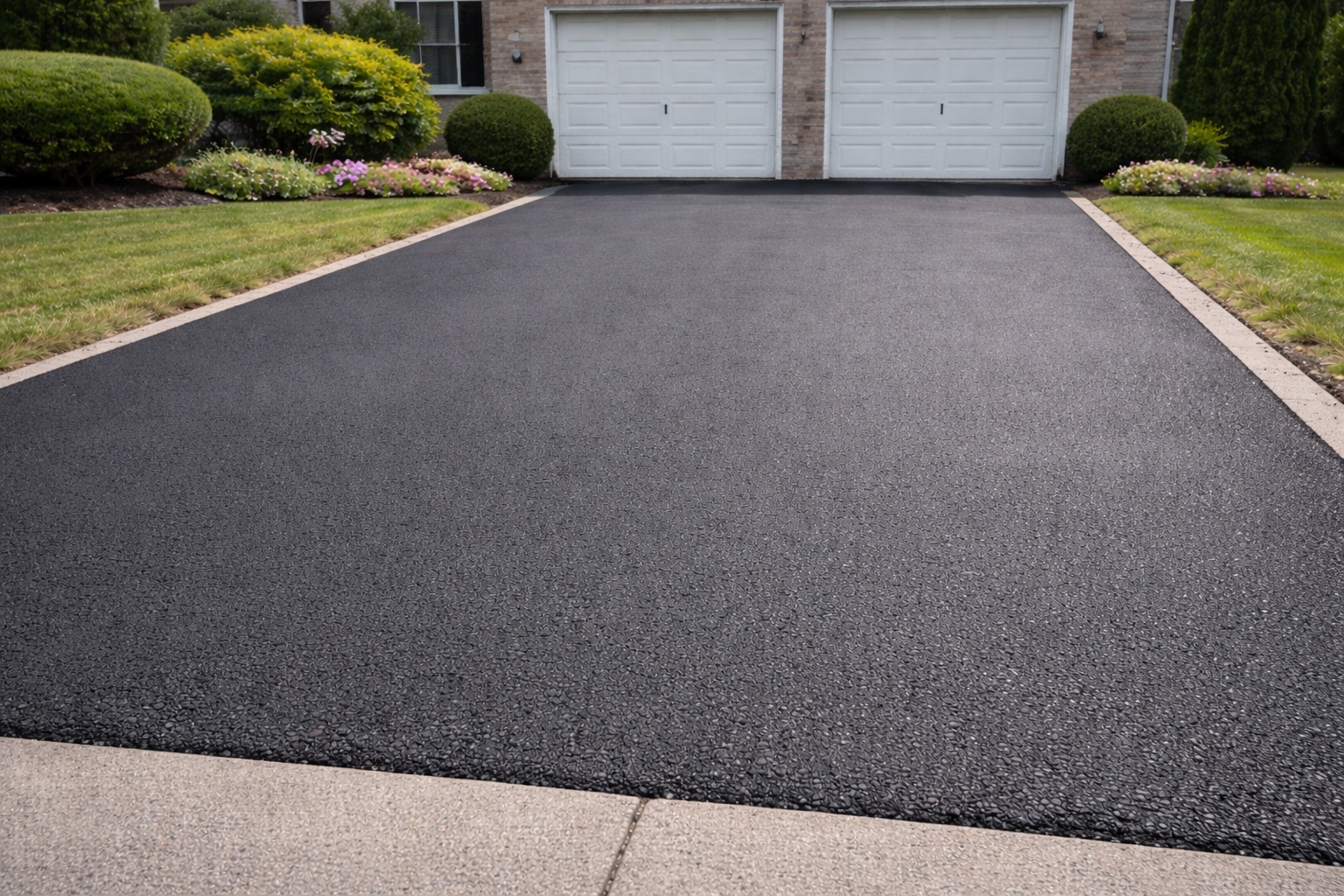
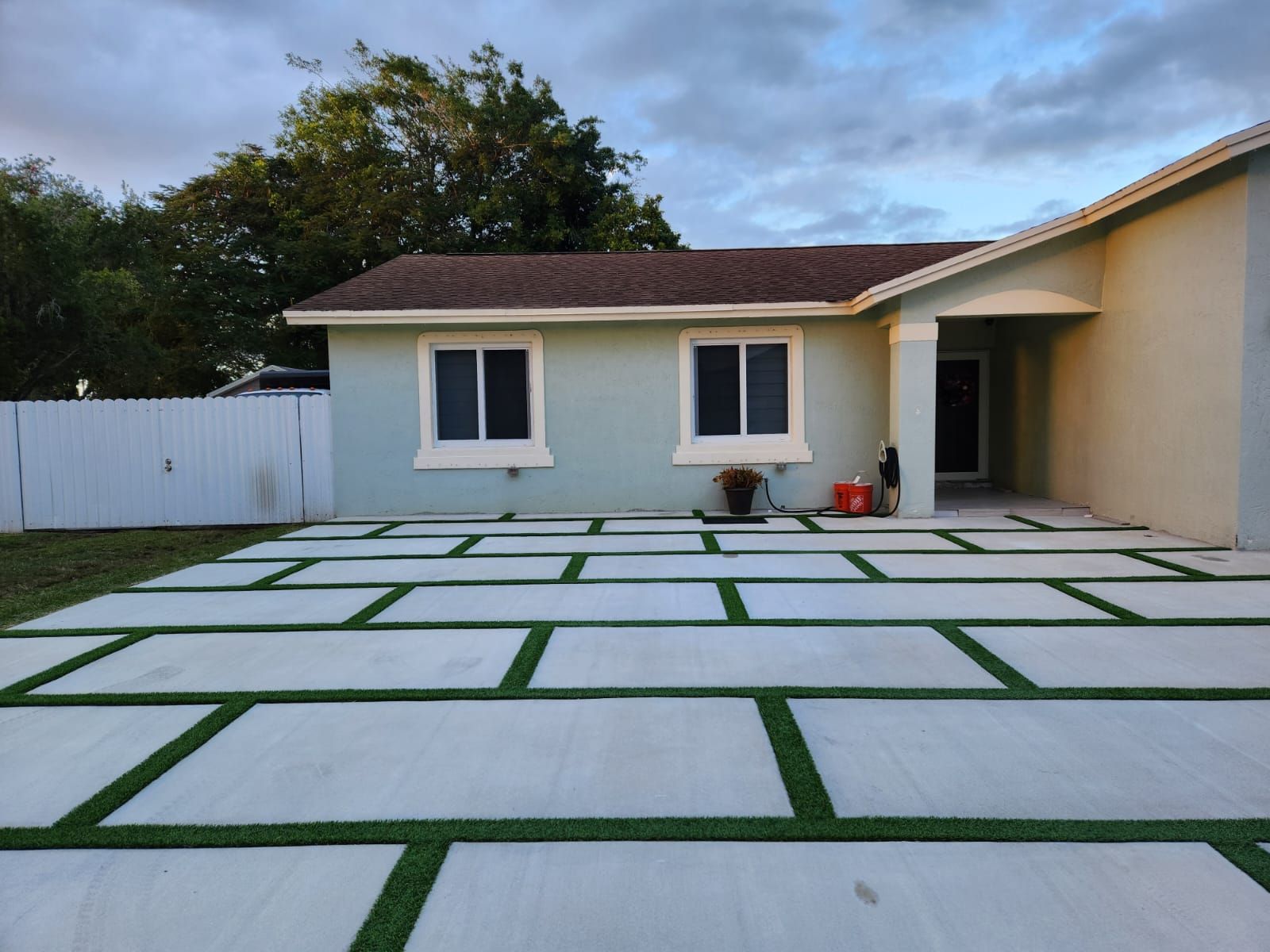
Driveway replacement in the Bay Area is one of those projects that homeowners put off until the cracking, heaving, and crumbling becomes impossible to ignore. The video above shows a complete concrete driveway makeover we completed for a Bay Area homeowner – from the cracked, uneven original surface to a clean, freshly poured concrete driveway that adds real curb appeal and function to the property.
In this article we cover everything you need to know before starting a driveway replacement project: when repair is no longer enough, what material makes sense for your property and budget, what the replacement process actually looks like from demo to cure, and what it costs in today’s Bay Area market. If you are on the fence about whether to patch or replace, keep reading – the answer is usually clearer than people think.
Quartz Construction & Demolition handles full driveway replacement across the Bay Area, including the demolition of the old surface, sub-base preparation, new concrete or paver installation, and all finishing work. We hold CSLB License #1003436 and serve homeowners in San Jose, Concord, Palo Alto, Redwood City, Milpitas, and surrounding cities.
Ready to Start Your Project?
Call Quartz Demolition & Construction for a free on-site estimate.
Serving 39 Bay Area cities — Concord, San Jose, Fremont, Walnut Creek & more.
Licensed & Insured · CSLB #1003436 · Bay Area CA
When to Replace vs. Repair Your Driveway
Homeowners are often tempted to patch a failing driveway to save money in the short term. Sometimes patching makes sense. But in many cases, patching extends the misery without solving the underlying problem. Here is how to think through the decision:
Repair makes sense when:
- Cracks are surface-level and less than 1/4 inch wide
- The driveway is relatively young (under 10 years old)
- Only a small section has failed and the rest is structurally sound
- The sub-base is intact and there is no heaving or significant settlement
Replace when:
- Cracks are widespread, deep, or alligator-patterned (spiderweb cracking)
- The surface has heaved, settled, or shows significant height differences between sections
- Water pools on the surface or drains toward the house
- The driveway is 20+ years old and has received multiple prior patches
- You are making other improvements to the home and want fresh curb appeal
The Bay Area’s climate – wet winters, dry summers, occasional freeze events in higher elevations – is tough on driveways. Tree roots are also a major issue throughout the region, as mature oaks, maples, and other Bay Area trees are notorious for destroying driveway slabs from below.
If your driveway has multiple cracked sections, heaving from roots or soil movement, or drainage problems, you are past the point where patching will give you more than a year or two of improvement. Not sure which category your cracks fall into? Our guide on telling normal shrinkage cracks from problem cracks walks through the checklist. If it is the latter, replacement is the right investment.
Concrete vs. Pavers: Choosing the Right Driveway Material
The two most common driveway materials in the Bay Area are poured concrete and concrete pavers. Each has real advantages depending on your priorities.
Poured Concrete Driveways:
- Lower upfront cost than pavers in most cases
- Clean, uniform look that works well with modern and traditional homes
- Very durable when properly installed with correct sub-base and expansion joints
- Easier to maintain in the short term
- If a section cracks badly, repair can be more visible than paver repairs
- Good lifespan: 25-30+ years with proper installation
Concrete Pavers:
- Higher upfront cost, but individual pavers can be replaced if damaged
- Extremely wide range of colors, textures, and patterns
- Permeable options available for better drainage and stormwater management
- Adds premium curb appeal and perceived home value
- Requires periodic re-sanding of joints and occasional re-leveling
- Also 25-30+ year lifespan with proper care
For most Bay Area homeowners replacing a standard driveway, poured concrete delivers the best value. For homeowners investing in full front yard redesign or trying to match high-end pavers on the home exterior, pavers make a compelling choice.
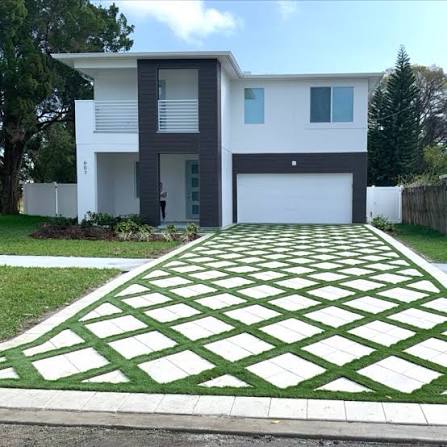
Quartz Construction & Demolition installs both. You can explore our concrete driveway installation service and our driveway pavers service to see examples of our work.
The Driveway Replacement Process: Step by Step
Understanding what happens during driveway replacement helps you plan for the project and set expectations with your household. Here is the complete process from first day on-site to final cure:
Step 1: Demo of the Existing Driveway
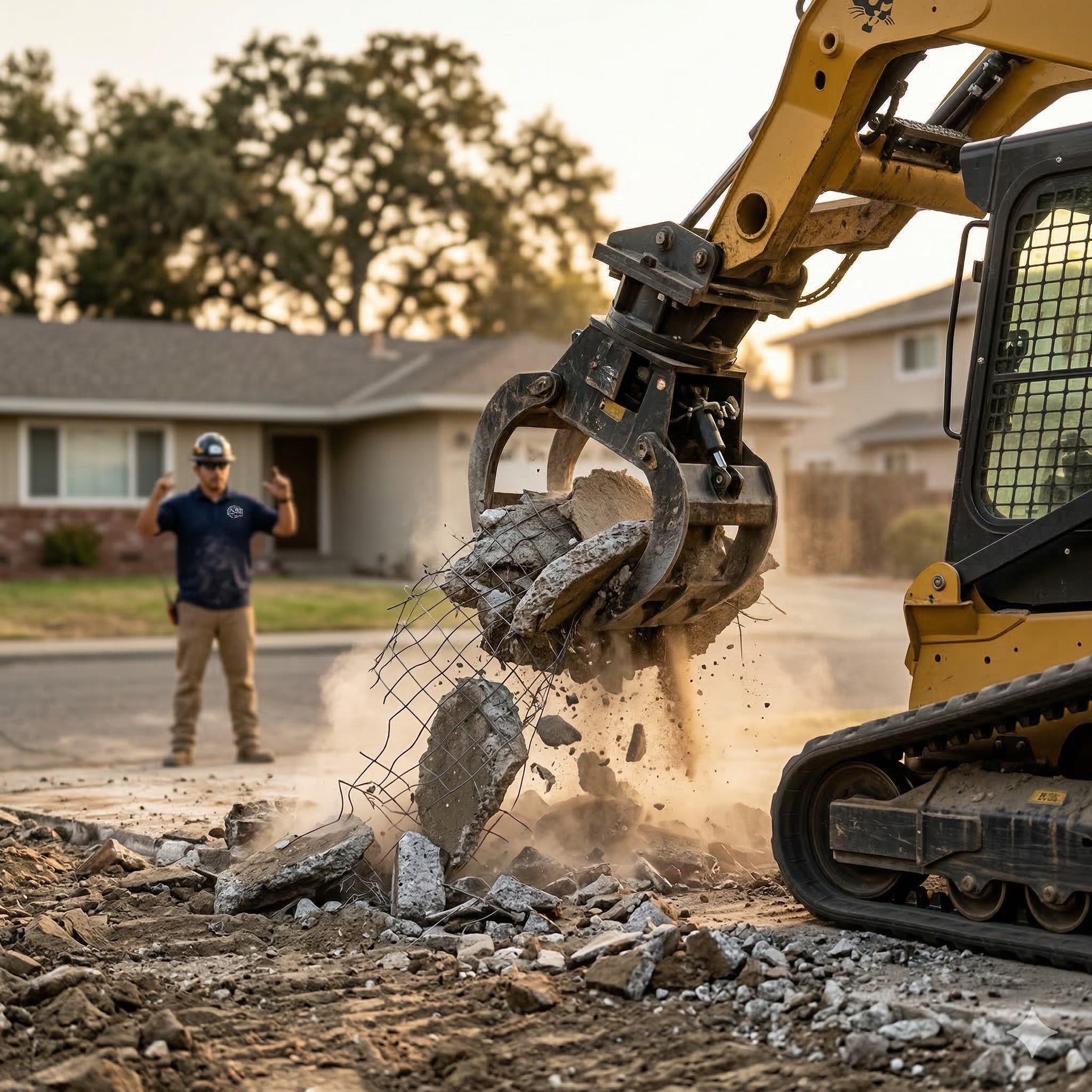
The existing concrete or asphalt is broken up using a jackhammer, Bobcat with a breaker attachment, or excavator. All debris is loaded into dump trucks and hauled away. This part of the job is loud and generates significant concrete rubble, which we handle entirely. Related service: driveway demolition.
Step 2: Sub-Base Inspection and Preparation
This is the step that separates a quality driveway replacement from a future problem. Once the old slab is removed, we inspect the soil condition below. If there is soft or unstable soil, tree roots, or drainage issues, those problems must be addressed before any new concrete goes down.
We typically excavate to the proper depth and install a compacted aggregate base (Class II road base is standard in California). Proper base depth and compaction are the most important factors in how long your new driveway will last.
Step 3: Forms, Reinforcement, and Expansion Joints
Wooden forms are set to define the edges and thickness of the new slab. Wire mesh or rebar is placed for reinforcement. Expansion joint locations are planned to control where the concrete cracks as it expands and contracts – this is what prevents the uncontrolled cracking you see in older driveways with no planned joints.
Step 4: Concrete Pour
Ready-mix concrete is delivered by truck and poured into the forms. For a standard residential driveway in the Bay Area, we use 4,000 PSI concrete (sometimes 3,500 PSI depending on use and soil conditions). The concrete is screeded level, floated, and finished with a broom texture for traction.
Step 5: Curing
Concrete must cure properly to reach full strength. We apply a curing compound immediately after finishing to retain moisture. Vehicle traffic should stay off the slab for at least 7 days (longer in cooler weather). Full strength is reached at 28 days.
Total project time (not counting permit processing): most residential driveways are completed in 1-3 days.
Sub-Base Preparation: The Most Important Part Nobody Talks About
We want to spend extra time on sub-base prep because this is where many contractors cut corners and where driveway failures originate.
The Bay Area has a wide variety of soil conditions. Clay-heavy soils – very common in the East Bay and parts of the South Bay – expand when wet and contract when dry. This cycle of movement is one of the main reasons driveways crack prematurely. Without proper base preparation that accounts for local soil conditions, even a well-poured concrete slab will crack within a few years.
Our process includes:
- Excavating to the correct depth (typically 6-8 inches below finished grade for residential driveways)
- Removing any organic material, tree roots, or unstable soil
- Installing and compacting Class II aggregate base in lifts
- Verifying grade for proper drainage slope away from the house
Proper drainage slope is 1/8 to 1/4 inch per foot away from the structure. This small detail prevents water from pooling near your foundation – a serious issue in the rainy Bay Area winters.
If you have had a contractor pour concrete over your old base without removing the existing material first, that is also a common source of premature failure. Always ask your contractor specifically what they plan to do with the sub-base.
Driveway Replacement Cost in the Bay Area
Bay Area driveway replacement costs more than the national average due to higher labor costs, local permit requirements, and disposal fees. Here is a realistic price breakdown:
Concrete driveway replacement (poured):
- Small driveway (1-2 cars, up to 400 sq ft): $4,000 – $8,000
- Standard driveway (2 cars, 400-800 sq ft): $6,000 – $14,000
- Large driveway (3+ cars or long approach, 800-1,500 sq ft): $12,000 – $22,000+
Concrete paver driveway replacement:
- Add approximately 30-60% to the above ranges for pavers depending on material and pattern
Factors that affect your specific cost:
- Demo and disposal of existing surface
- Sub-base condition and depth required
- Tree root removal
- Drainage corrections
- Permit fees (vary by city)
- Access constraints (narrow lots, gates, limited truck access)
- Stamped or decorative finish (adds cost)
Stamped concrete driveways are popular in the Bay Area for homeowners who want the look of pavers at a lower cost. We offer stamped concrete as a finish option for driveways and patios.
Permits for Driveway Replacement in the Bay Area
Many homeowners are surprised to learn that driveway replacement often requires a permit in Bay Area cities. Requirements vary by jurisdiction:
- Some cities require permits only if you are changing the size or configuration of the driveway
- Others require a permit for any new concrete pour in the public right-of-way (the strip between your property and the street)
- Cities with green infrastructure requirements may require permeable pavers or drainage controls
Quartz Construction & Demolition researches the specific permit requirements for your city before providing a quote. We pull all necessary permits and handle the inspection process. You do not need to navigate the building department yourself.
Frequently Asked Questions About Driveway Replacement
Q: How long does a driveway replacement take in the Bay Area?
A: The physical work typically takes 1-3 days: one day for demo and sub-base prep, one day for forming and pouring. Then the concrete needs 7 days before you can drive on it. Total project timeline from first contact to driving on your new driveway is usually 2-4 weeks (including permit processing).
Q: Can I park on the street while my driveway is being replaced?
A: Yes. You will need to make alternate parking arrangements for approximately 7-10 days while the concrete cures. We advise neighbors in advance when our work may temporarily affect street access.
Q: Should I get concrete or pavers for my Bay Area driveway?
A: Both are excellent choices. Concrete is more cost-effective for most projects. Pavers offer more design flexibility and easier individual repair but cost more upfront. We are happy to walk you through both options during your free site estimate.
Q: My driveway has tree roots growing under it. Do you handle root removal?
A: Yes. Tree root intrusion is very common in Bay Area driveways. We excavate the affected area, remove the roots, and evaluate whether a root barrier should be installed to protect the new slab. This is addressed during sub-base preparation.
Q: Do you offer financing for driveway replacement?
A: Yes, Quartz Construction & Demolition offers financing options for qualified customers. Visit our financing page to learn more.
Start Your Bay Area Driveway Replacement Today
Watch Our Work in Action
Watch our project videos on YouTube
Watch on YouTubeQuartz Construction & Demolition handles driveway replacement from start to finish across the Bay Area – demo, grading, forming, pouring, and finishing. We serve San Jose, Mountain View, Redwood City, San Mateo, Milpitas, Alameda, Los Gatos, Palo Alto, Concord, Danville, and surrounding communities.
CSLB License #1003436. Fully insured. Free on-site estimates.
California requires all concrete and driveway contractors to hold a valid license. Verify credentials at the California Contractors State License Board (CSLB). Always obtain a permit before starting work.
Call +1 (408) 966-2704 or visit quartzconstructionanddemolition.com/driveway-replacement/ to schedule your free consultation.
Related Articles
What Our Customers Say
"I had small repair job needed for my mother. They responded quickly and did excellent work and I will definitely use them again."
"I had a great experience working with Ohad and his team on my yard project! From start to finish, the communication..."
"We just finished backyard renovation and pergola project with Quartz Construction and Demolition. From start to finish..."
Ready to Start Your Project?
Call Quartz Demolition & Construction for a free on-site estimate.
Serving 39 Bay Area cities — Concord, San Jose, Fremont, Walnut Creek & more.
Licensed & Insured · CSLB #1003436 · Bay Area CA
Frequently Asked Questions
- Q: How do I know if I should repair my driveway instead of replacing it?
- A: Repair generally makes sense when cracks are surface-level and less than 1/4 inch wide, the driveway is under 10 years old, only a small section has failed, and the sub-base underneath is still intact with no heaving or settlement. If those conditions are true, patching can reasonably extend the driveway's life without a full replacement.
- Q: What are the signs that a driveway needs full replacement rather than a patch?
- A: Replacement is the right call when cracks are widespread, deep, or alligator-patterned, when the surface has heaved or settled with visible height differences between sections, or when water pools on the surface or drains toward the house. It's also usually time to replace once the driveway is 20+ years old and has already received multiple prior patches, since patching at that point just delays the real fix.
- Q: Why do driveways in the Bay Area fail so often from tree roots?
- A: Mature oaks, maples, and other Bay Area trees are notorious for pushing up and cracking driveway slabs from below as their root systems grow. Combined with the region's wet winters and dry summers, this makes tree root intrusion one of the most common reasons Bay Area driveways need full replacement rather than a simple patch.
- Q: Is Quartz licensed to handle driveway replacement, and where do they work?
- A: Yes, Quartz Construction & Demolition holds CSLB License #1003436 and handles the full driveway replacement process — demolition of the old surface, sub-base preparation, and new concrete or paver installation. They serve homeowners in San Jose, Concord, Palo Alto, Redwood City, Milpitas, and surrounding Bay Area cities.