
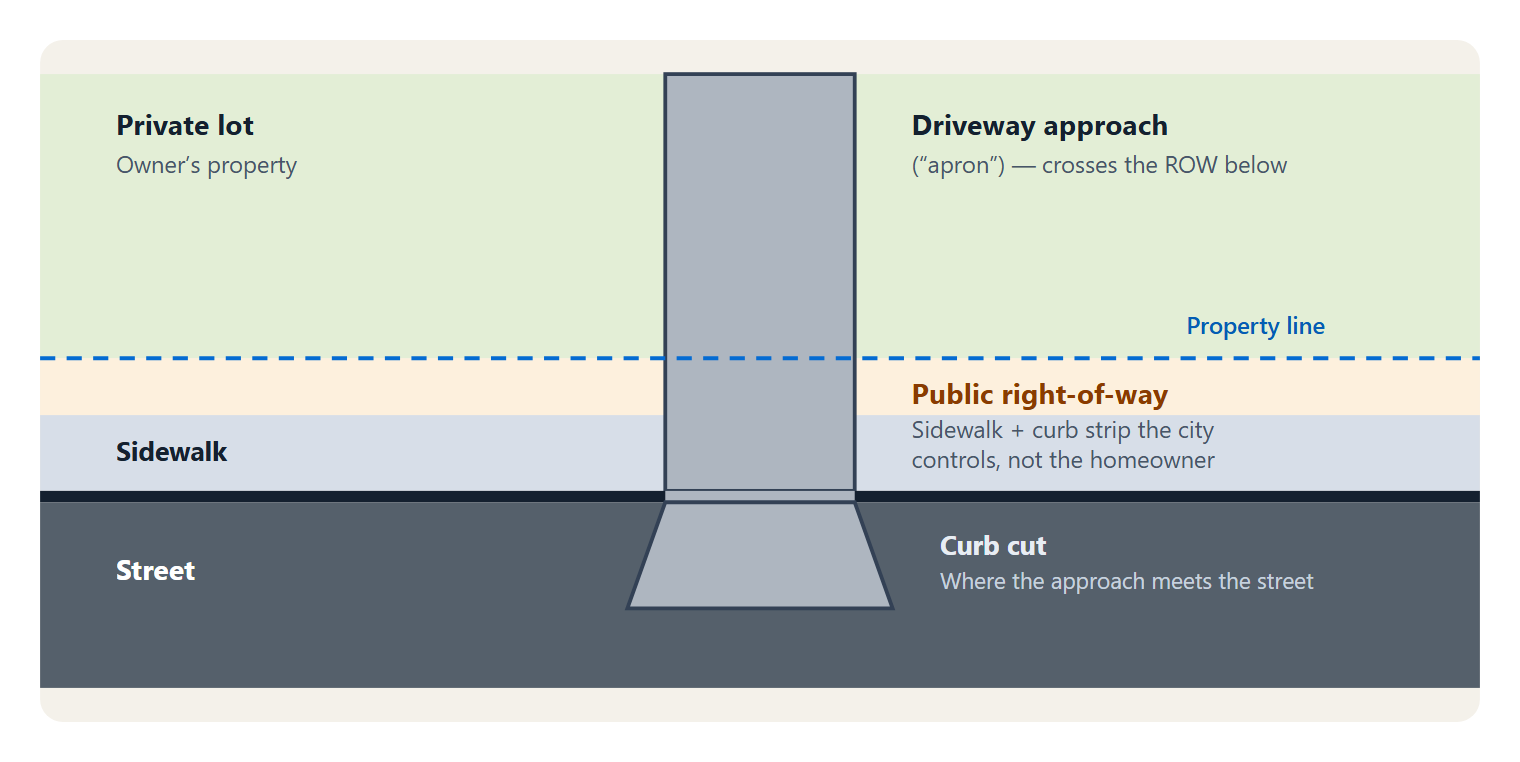
The concrete between a garage and the street looks like one continuous driveway, but it isn’t all the homeowner’s to redo without asking. The section that crosses the sidewalk and ties into the curb — the “approach” or “apron” — sits in the public right-of-way. That is why replacing, widening or relocating a driveway approach usually means a separate encroachment permit from the city, on top of (or sometimes instead of) any building permit for the driveway itself. The exact trigger, paperwork and review time are different in every city.
Before pouring, widening or relocating a driveway approach:
- 1The approach itself is public property. The strip crossing the sidewalk and meeting the curb sits in the city’s right-of-way, even though the homeowner paid for it and uses it exclusively.
- 2Most cities require an encroachment permit for driveway-approach work, separate from any building permit. San Jose is the exception that proves the rule: it generally exempts a replacement in the same footprint.
- 3Plans, insurance and sometimes a traffic control plan are the common asks — not just a fee.
- 4Review time varies widely, from a same-day counter permit to a multi-week review for a new curb cut.
Where the city’s property starts
A standard residential lot ends at the property line, usually somewhere behind the sidewalk. From there to the street — the planting strip, the sidewalk and the curb — is the public right-of-way. Dublin’s public works department describes that right-of-way as typically extending about 8 feet from the face of the curb. A homeowner’s driveway approach has to cross that entire strip to connect the private driveway to the street, which puts a chunk of “the driveway” under city jurisdiction even though no one but the homeowner parks on it.
Because that strip belongs to the city, altering it — a new curb cut, a wider apron, a relocated approach — is treated as encroachment on public property, separate from whatever permit covers the private part of the driveway.
Four cities, four different processes
We checked how four cities in our service area handle a driveway-approach encroachment permit (checked October 17, 2026). Processes change, so confirm with the city before you schedule work.
| City | What triggers the permit | Where to apply | Worth knowing |
|---|---|---|---|
| Concord | Any work in the right-of-way, including driveway approach, curb, gutter and sidewalk | Engineering Division, online permit portal | Must follow city Standard Plans and Specifications; fee amount confirmed when the permit is ready to issue |
| Dublin | Construction, replacement or widening of a driveway approach | Public Works, dublin.ca.gov/CSS | Reviewed within 30 working days (about six weeks) under Municipal Code §7.04.190; right-of-way runs roughly 8 ft from the curb |
| San Jose | A new curb cut (new driveway or sidewalk) | Public Works Development Services, sjpermits.org or the Public Works counter | Replacing a driveway in the same footprint is generally routed to Transportation instead — see below |
| Pleasanton | Repair or replacement of a driveway approach, curb/gutter or sidewalk | Engineering Department, 200 Old Bernal Ave | Governed by Municipal Code Ch. 13.04; needs plans/sketch, a traffic control plan and liability insurance naming the city |
Two patterns stand out. First, every city except San Jose treats any approach work — even a straight repair in the same footprint — as encroachment requiring a permit. Second, review time is not uniform: Dublin states a formal 30-working-day window for a decision, while Pleasanton issues many encroachment permits over the counter once the paperwork is complete. Build the permit timeline into the project schedule before committing to a start date.
San Jose’s same-footprint exception
San Jose’s Public Works Development Services Division issues Driveway/Sidewalk permits for new driveways and sidewalks at single-family homes — the kind of permit triggered by a new curb cut. But for a straight swap, removing and replacing an existing driveway in the same location with no change to the curb cut, the city generally points homeowners to the Department of Transportation instead of the encroachment process. That is a meaningfully different path (different department, different review), so it is worth confirming which one applies before assuming “replacing my driveway” means the same paperwork as “adding a new one.”
Likely a new curb cut — plan on Development Services
- Driveway in a new location, or a second driveway
- Widening the apron beyond the existing curb cut
- No driveway there currently
Same footprint, no curb-cut change — ask Transportation first
- Removing and replacing an existing driveway in place
- Repairing cracked or settled approach concrete
- Still confirm by phone: San Jose’s Transportation line is (408) 794-1901
Either way, San Jose’s driveway applications ask for the proposed driveway width and the distance from the face of curb to the property line, with a minimum of about 8 feet or a dedication may be required. Other cities in our service area don’t offer a comparable same-footprint exception — Concord, Dublin and Pleasanton all route approach work through their standard encroachment permit regardless of whether the footprint changes. Confirm directly with each city before assuming San Jose’s rule applies elsewhere.
What these departments ask for
The forms differ, but the documents cities want for right-of-way work are similar across our service area:
- A site plan or sketchPleasanton’s application asks for three copies of the proposed-work plans, at minimum a Google overview map with a sketch of the work.
- Liability insurancePleasanton requires a copy of liability insurance with endorsements naming the City of Pleasanton as additional insured, plus a waiver of subrogation. Confirm the equivalent requirement with each city.
- A traffic control planNeeded when the work affects the sidewalk or street. Pleasanton allows 48 hours to approve a traffic control plan once submitted.
- Compliance with city standard plansConcord requires work to follow its Standard Plans and Specifications; most cities reference their own standard details for concrete thickness, slope and curb-cut geometry.
None of this replaces a city-specific call before work starts. A five-minute conversation with the Engineering or Public Works counter is the fastest way to confirm which permit applies, what the current fee is, and how long review is taking right now.
Before you apply
Driveway-approach permit pre-check
Tick each item when you have the answer. The checklist works without JavaScript; with it on, ticks are saved in this browser only.
If any answer is “not sure,” call the city before concrete gets ordered. An encroachment permit pulled after work starts can mean a stop-work notice, not just a fine.
Questions homeowners ask
Is an encroachment permit the same as a driveway permit?
Not necessarily. “Encroachment permit” refers to work in the public right-of-way — the sidewalk, curb and the part of the approach that crosses them. A separate building or driveway permit can also apply to the private portion of the driveway. Some cities combine these into one application; others issue them separately. Ask the city which applies to your project.
Do I need a permit just to repair a cracked driveway approach?
In Concord, Dublin and Pleasanton, repair or replacement of the approach is still treated as right-of-way work and generally needs an encroachment permit. San Jose is the exception: a replacement in the same footprint with no curb-cut change is generally routed to the Department of Transportation rather than through the standard encroachment process — confirm by phone either way.
How wide does a driveway approach have to be?
It is set by each city’s standard plans, not a single statewide number. San Jose’s driveway application asks for the proposed driveway width and the face-of-curb-to-property-line distance, citing a minimum of roughly 8 feet or a dedication may be required. Confirm the specific dimension requirement with your city’s public works or engineering department.
How long does a driveway-approach encroachment permit take?
It depends on the city. Dublin states a formal review window of 30 working days (about six weeks) for approval, conditional approval or denial. Pleasanton issues many encroachment permits at the Engineering counter once the required plans, traffic control plan and insurance documents are complete. Ask the specific city for its current timeline before scheduling work.
Does digging out the old approach require calling 811?
Removing and repouring a driveway approach involves excavation near the curb, where utility laterals and service lines often run. California law requires calling 811 at least two working days before excavation, regardless of the encroachment permit. See our guide to calling 811 before you dig.
Planning a new or replacement driveway?
Tell us the city and what you have in mind, and we’ll help you figure out which permit applies before any concrete is ordered. Quartz Construction & Demolition holds California contractor license #1003436, which you can verify on the CSLB website.
Related services and guides
- ServiceDriveway installation
- ServiceConcrete driveway installation
- ServicePaver installation
- GuideDriveway installation: materials, timeline and cost
- GuideDriveway pavers vs. asphalt
- GuideCall 811 before you dig
Sources
Watch Our Work in Action
Watch our project videos on YouTube
Watch on YouTube- City of Concord, Encroachment Permits — right-of-way work covered, application process, Engineering Division contact (checked October 17, 2026).
- City of Dublin, Public Works Permits — driveway-approach encroachment trigger, right-of-way extent, Municipal Code §7.04.190 review timeline.
- City of San Jose, Encroachment Permits — Driveway/Sidewalk permit scope and the same-footprint routing to Transportation (checked via search-indexed content; direct automated fetch returned HTTP 403).
- City of Pleasanton, Engineering Division, and the Encroachment Permit Application — required documents, Municipal Code Ch. 13.04, contact information.
- CSLB Check a License — verify any contractor’s license, including ours (#1003436).
General information, not legal advice and not a Quartz quote. Encroachment permit rules, fees and review times are set by each city and change over time. Confirm current requirements for your address with the local public works or engineering department before you build.
What Our Customers Say
"I had small repair job needed for my mother. They responded quickly and did excellent work and I will definitely use them again."
"I had a great experience working with Ohad and his team on my yard project! From start to finish, the communication..."
"We just finished backyard renovation and pergola project with Quartz Construction and Demolition. From start to finish..."