
A French drain collects water. It doesn’t make it disappear. Every foot of gravel and perforated pipe in the ground still has to end somewhere, and where that “somewhere” is turns out to matter — legally, not just practically. Send it to the wrong place and you can end up with a notice from the city, a dispute with a neighbor, or a drain that quietly stops working. Here’s what the water is actually allowed to do once it leaves the trench.
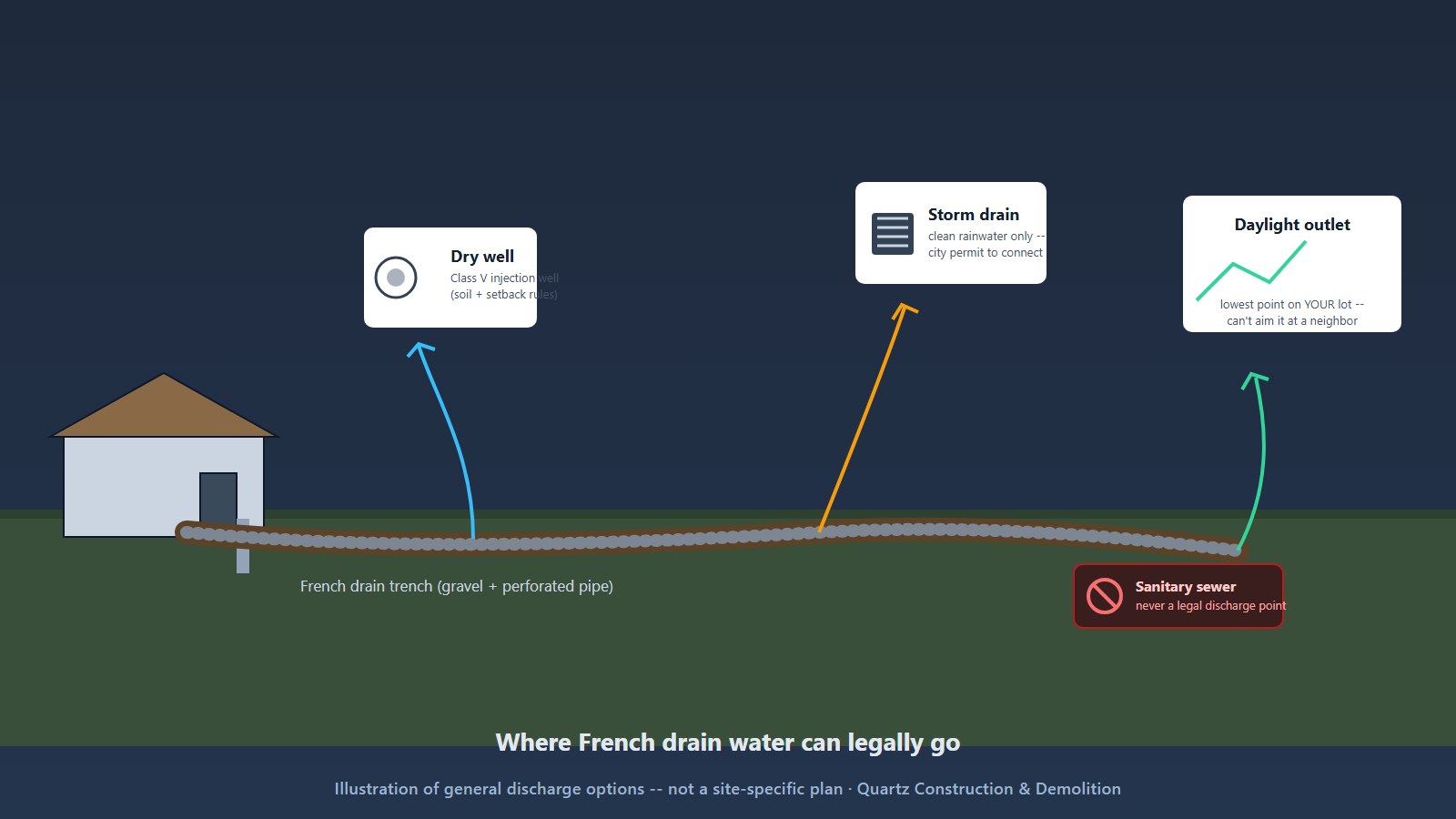
Three legal destinations, one hard no:
- 1Daylight, at the lowest point on your own lot — the simplest option, but California law limits how much you can concentrate or accelerate that flow before it becomes a neighbor’s problem.
- 2A dry well — federally regulated as a Class V injection well, with state and sometimes county rules layered on top, and a poor fit for the clay soil common across the inland Bay Area.
- 3The municipal storm drain — usually allowed for clean water, but connecting a pipe to it is a permit question for your city, not a DIY decision.
- 4The sanitary sewer is not an option. Sewer systems are sized for wastewater, not the sustained flow a French drain adds, and most local sewer-use ordinances prohibit the connection outright.
Why “just send it toward the fence line” isn’t really an option
The simplest-sounding fix — run the pipe to the low side of the yard and let gravity do the rest — is legal in principle, but it comes with a real limit. California follows what courts call a modified civil-law “reasonable use” rule for surface water between neighboring properties. The California Supreme Court’s decision in Keys v. Romley lays out the standard: an upper (higher-elevation) landowner is generally entitled to let water drain as it naturally would, but is liable for damage caused by discharging it in an “unnatural manner.” Courts weigh the amount of harm caused, how foreseeable that harm was, and whether the benefit to the upper owner’s use of their land outweighs the burden placed on the lower owner.
In plain terms: a French drain that quietly daylights at your own low corner and soaks into your own planting bed is a very different thing, legally, than a pipe that collects water from a wide area and shoots it in a concentrated stream onto a neighbor’s lawn or against their fence. The first is ordinary use of your land. The second is exactly the kind of “concentrate, accelerate or artificially increase” drainage that Keys v. Romley and later cases hold an upper owner responsible for.
A daylight outlet should end on your property, not aimed at someone else’s. If the natural low point of your lot happens to sit right at the property line, that’s a conversation worth having with a neighbor before the pipe goes in — and often a reason to route toward a dry well or storm drain connection instead.
What federal rules actually say about this water
Municipal storm drain systems (MS4s) operate under federal Clean Water Act permits that require cities to prohibit “illicit discharges” — EPA defines an illicit discharge as any discharge to the storm drain system that isn’t composed entirely of stormwater. That’s the source of the simple rule most Bay Area clean-water programs post for residents: Contra Costa Clean Water Program’s public guidance states plainly that only rainwater is allowed to flow freely into a storm drain, with wash water, sediment and similar pollutants prohibited.
What’s less publicized is EPA’s own list of discharges that don’t have to be treated as illicit in the first place — and it reads like a description of a French drain: foundation drains, footing drains, uncontaminated groundwater infiltration, rising ground water, uncontaminated pumped groundwater, water from crawl space pumps, and landscape irrigation water are all on the federal exempted-category list. The clean groundwater a well-built French drain carries is generally the kind of water the federal rule doesn’t treat as a pollution problem.
That federal exemption answers one question — is the water itself acceptable — but not the other one: whether your city lets you physically tie a private pipe into its storm drain system. That’s a separate, local permission.
The storm drain: usually allowed, always a permit question
Generally fine to discharge
- Clean groundwater a French drain collects (rainwater, subsurface seepage)
- Water from a properly working perforated pipe with no sediment load
- A connection made with the city’s permit and inspection, at an approved point
Not allowed into a storm drain
- Sediment, mud or silt carried along with the water
- Pool or spa water that hasn’t been dechlorinated
- Any wash water, paint, oil or construction runoff
- A pipe tied in without the city’s permit or inspection
City of Concord’s own description of its encroachment permit process is typical of how Bay Area cities frame this: an encroachment permit is required for anyone who proposes to do work in, or connect to, the public right-of-way or a water course — which is exactly what tying a private drain line into the public storm system involves. Cities vary in how closely they police this for a small residential French drain, but “it’s probably fine” isn’t the same as “it’s permitted,” and an unpermitted connection discovered later (often during a resale inspection or a street project) is a more expensive problem than a phone call would have been.
Dry wells: the option with the most fine print
A dry well — a gravel-filled pit that lets water soak into deeper, more permeable soil — sounds like the self-contained option that avoids the neighbor question and the permit question both. In practice it has more regulation attached to it than either of the other two choices, not less.
Federally, a dry well counts as a Class V injection well under the EPA’s Underground Injection Control program (a “conduit for non-hazardous fluids deeper than it is wide”). EPA guidance specifically calls out dry wells serving lots other than single-family homes as subject to registration requirements; a single-family residential dry well generally falls outside that individual registration mandate. That’s the good news. Separately, though, California’s State and Regional Water Quality Control Boards have their own authority under the Porter-Cologne Water Quality Control Act to require a report of discharge for an injection well and to apply the state’s Anti-Degradation Policy, which protects high-quality groundwater from unnecessary degradation. The Bay Area’s own Regional Water Quality Control Board restricted dry well use back in 1951 specifically to protect groundwater quality, and the San Francisco Public Utilities Commission now steers people toward wide, shallow infiltration basins instead of the classic deep, narrow dry well.
Soil is the other problem. Design standards used in other parts of California — Los Angeles and San Diego’s stormwater permits, Placer County’s LID manual — generally call dry wells unsuitable in soil with more than 30% clay. The USDA’s official soil survey for the Diablo clay series, common across Alameda and Contra Costa counties, documents 45–60% clay through most soil horizons. That’s not a Bay Area-specific dry well standard (none of the sources above write one), but it’s a straightforward reason a dry well that works well in sandy soil elsewhere in the state can simply refuse to drain on a typical inland Bay Area clay lot.
Confirming your city’s rule before you dig
- Step 1Check your city’s public works or engineering pageSearch for “encroachment permit” and “storm drain connection” on your city’s site, or call the permit counter directly.
- Step 2Ask the direct question about a storm drain tie-inConfirm whether a private drain connection to the public storm system needs a permit and an inspected point of connection — in most Bay Area cities, it does.
- Step 3Ask about dry well rules if you’re considering oneLocal practice on dry wells varies by city and county far more than storm drain rules do; don’t assume what’s allowed one town over applies at your address.
- Step 4Confirm a daylight outlet stays on your own lotWalk the discharge point with the actual grading in mind — not just where the pipe is shortest, but where the water genuinely ends up once it leaves the pipe.
Before you pick a discharge point
Discharge-point check
Worth confirming before the trench gets backfilled.
Questions homeowners ask
Can I run my French drain straight to the street or curb?
Not without checking first. Water reaching the gutter from your own roof and yard during rain is normal, but a piped connection into the curb, gutter or storm drain system is treated as a connection to public infrastructure in most Bay Area cities and generally needs a permit, even for a small residential line.
Is it legal to drain water onto my neighbor’s property?
Generally no, if the drain concentrates or increases the flow beyond what would happen naturally. California’s reasonable-use rule (Keys v. Romley) holds an upper landowner liable for damage caused by discharging water in an unnatural, concentrated way onto a lower neighbor’s land, even though some natural surface flow between properties is expected.
Can French drain water go into the sanitary sewer?
No. Sanitary sewer systems are sized and billed for wastewater, not the sustained groundwater flow a French drain can add, and most local sewer-use ordinances prohibit connecting foundation or footing drains to the sewer line.
Do I need a permit just to install a French drain?
The drain itself (the trench, gravel and pipe) is typically minor residential work in most Bay Area cities. The permit question usually comes up specifically at the discharge point — connecting to the public storm drain system or, in some jurisdictions, installing a dry well — not the excavation itself. Confirm with your city before assuming either way.
What’s the difference between a dry well and just daylighting?
Daylighting lets water flow out onto the surface at a low point and spread or soak in from there. A dry well sends water underground into a gravel-filled pit designed to infiltrate into deeper soil. Dry wells are federally classified as injection wells with their own registration and siting rules; daylighting isn’t, but it comes with the neighbor-drainage limits described above instead. Our guide to French drains vs. catch basins vs. dry wells compares all three systems in more depth.
Planning a French drain and not sure where it should outlet?
We plan the discharge point as part of the drain design, not as an afterthought — matched to your lot’s grading, soil and your city’s rules. Quartz Construction & Demolition holds California contractor license #1003436, which you can verify on the CSLB website.
Related services and guides
- ServiceFrench drain installation
- ServiceYard drainage systems
- GuideFrench drain installation guide
- GuideFrench drains vs. catch basins vs. dry wells
- GuideIrrigation and drainage solutions
- GuideDrainage behind a retaining wall
Sources
Watch Our Work in Action
Watch our project videos on YouTube
Watch on YouTube- Keys v. Romley, California Supreme Court — California’s reasonable-use rule for surface water drainage between neighboring landowners (checked October 19, 2026).
- EPA, Stormwater Phase II Final Rule – Illicit Discharge Detection and Elimination (Factsheet 2.5) — definition of illicit discharge and the exempted non-stormwater category list including foundation and footing drains.
- Contra Costa Clean Water Program — resident-facing storm drain discharge guidance.
- OEHHA, Dry Wells: Uses, Regulations, and Guidelines in California and Elsewhere — EPA UIC Class V requirements, California Water Board authority, the Bay Area’s 1951 dry well restriction, and other-region design standards.
- City of Concord, Encroachment Permits — general right-of-way/water course encroachment permit requirement.
- USDA NRCS Official Series Description, Diablo series — clay content referenced for Alameda/Contra Costa county soils (previously verified for our paver base and driveway thickness guides).
- CSLB Check a License — verify any contractor’s license, including ours (#1003436).
General information, not legal advice. Discharge rules vary by city and county; confirm the exact requirement for your address with your local public works or engineering department before connecting to a storm drain or siting a dry well.
What Our Customers Say
"I had small repair job needed for my mother. They responded quickly and did excellent work and I will definitely use them again."
"I had a great experience working with Ohad and his team on my yard project! From start to finish, the communication..."
"We just finished backyard renovation and pergola project with Quartz Construction and Demolition. From start to finish..."